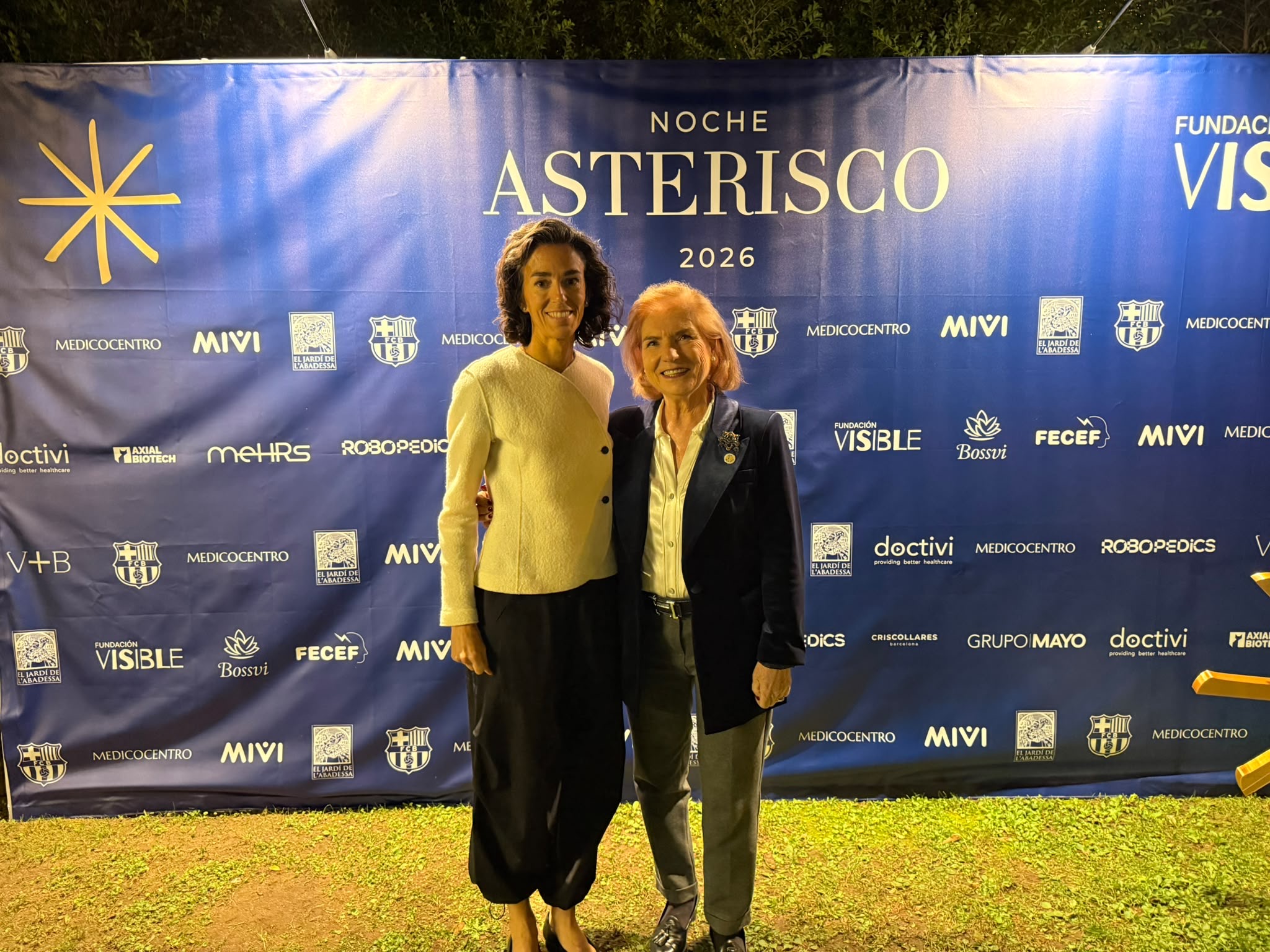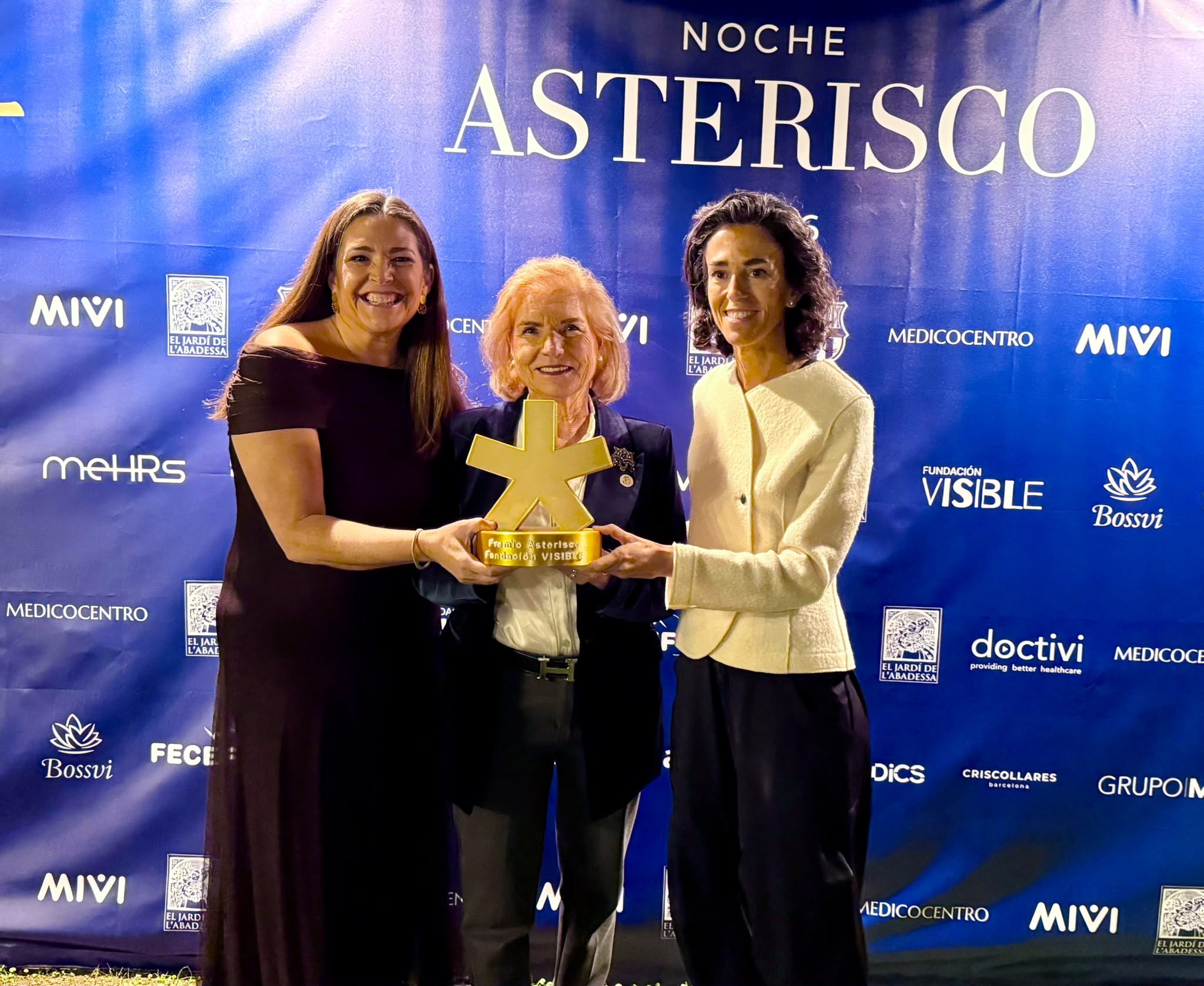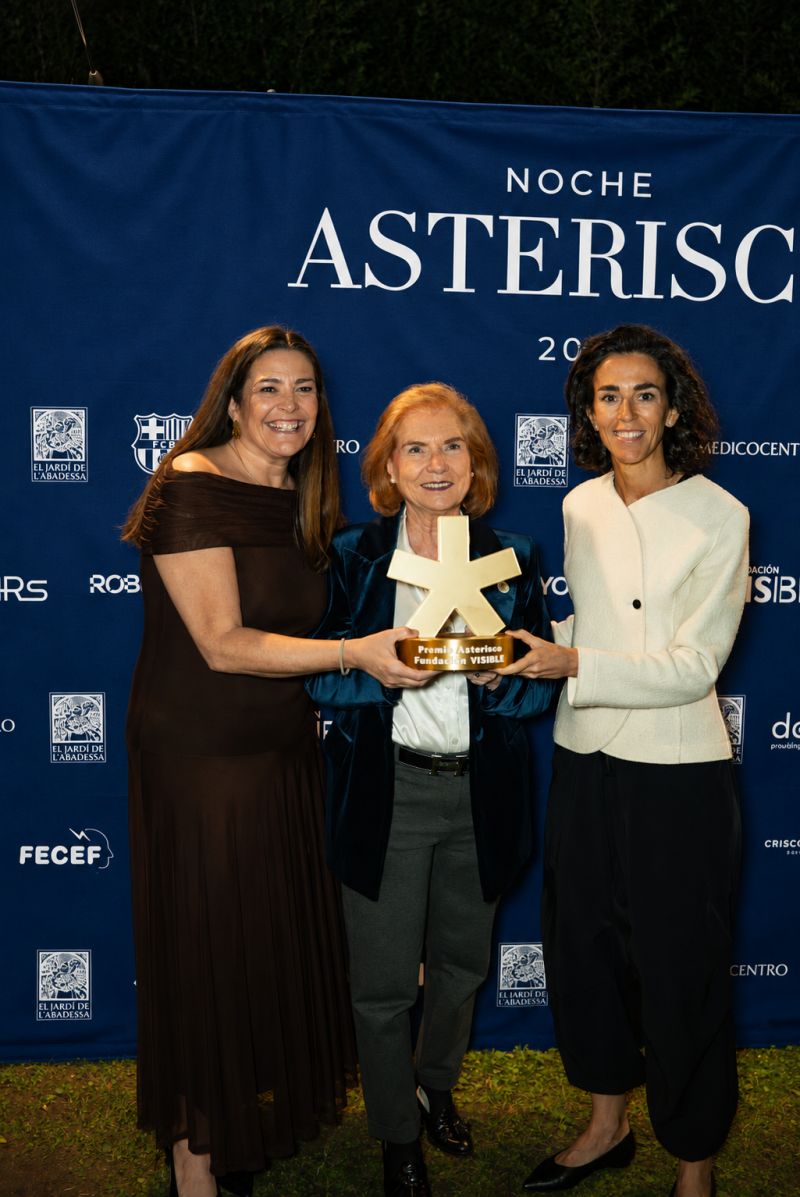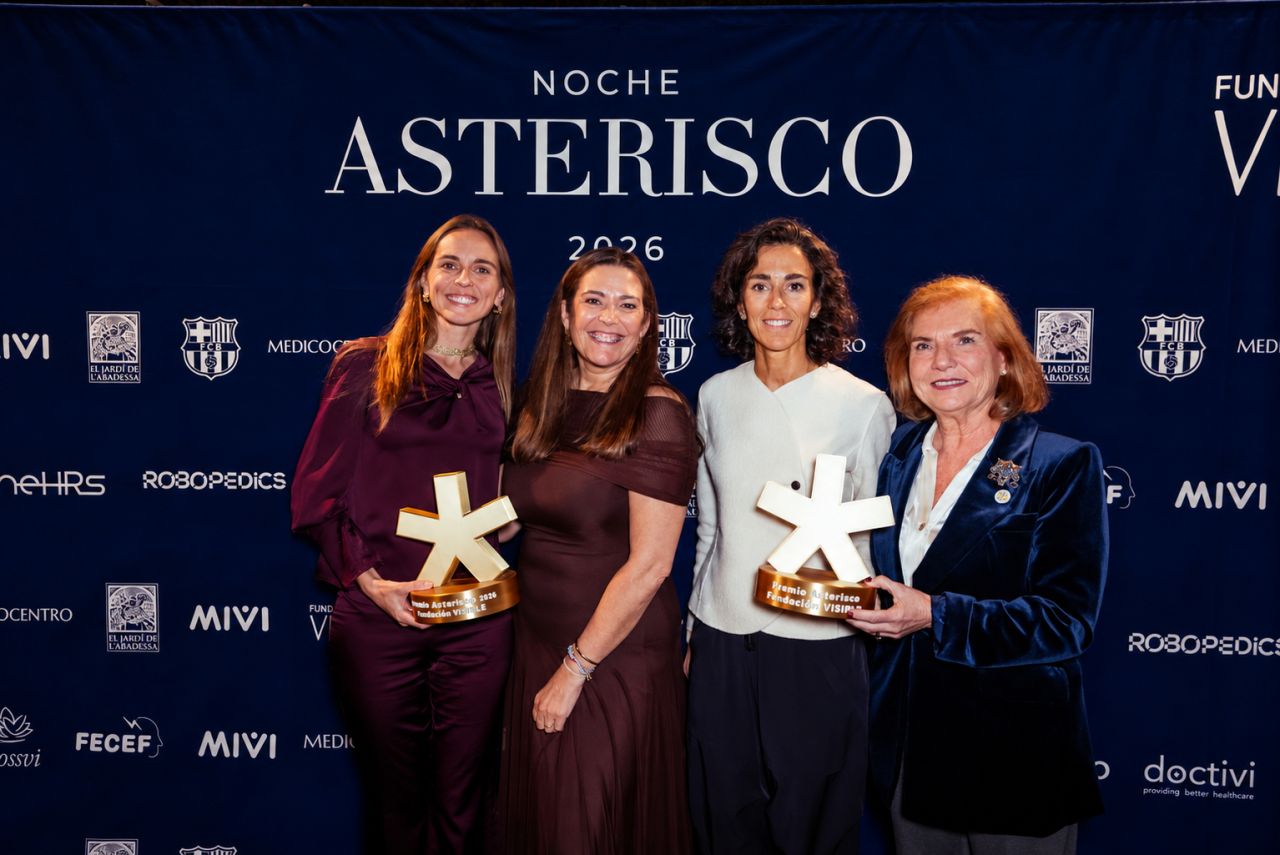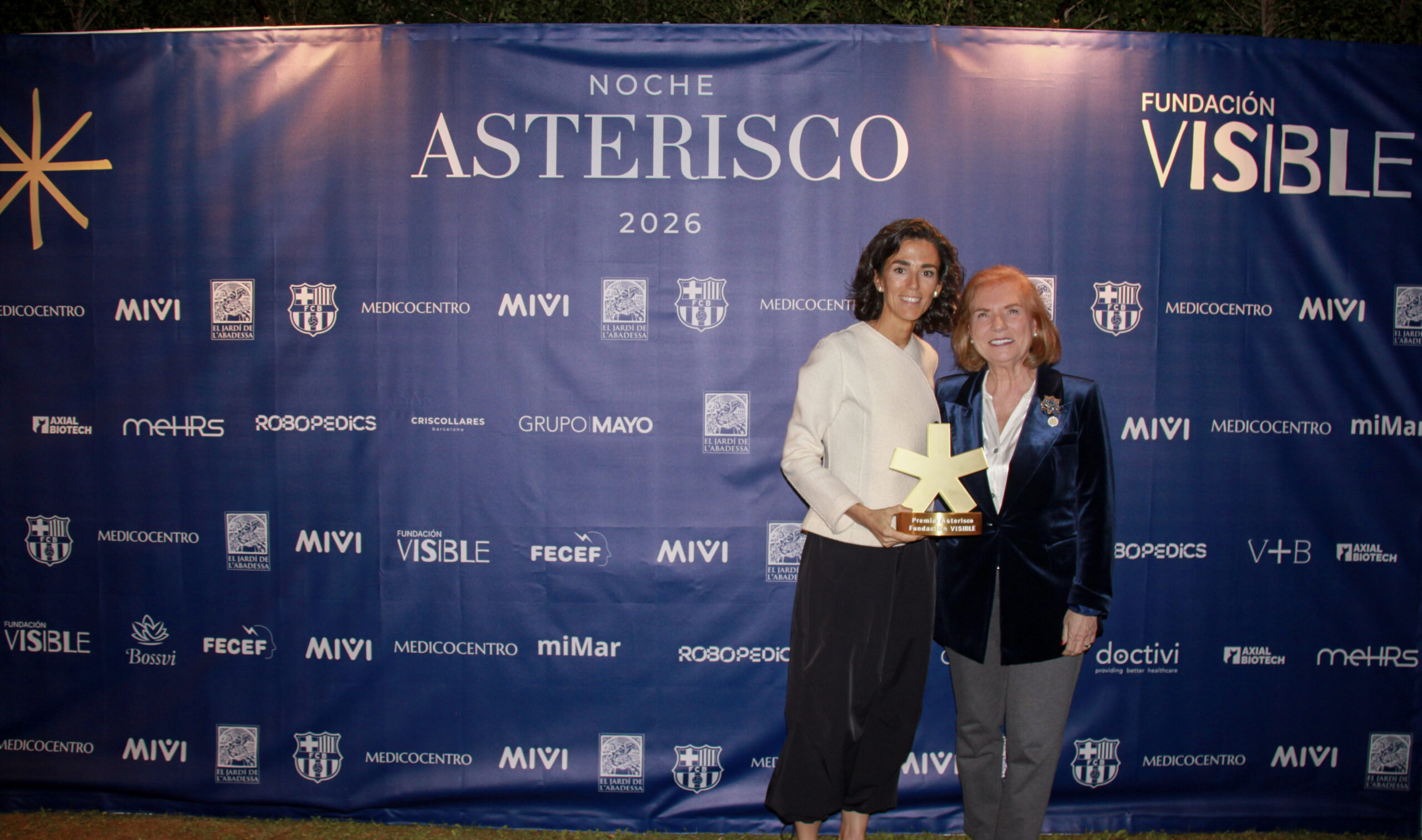
Elena Ruiz de la Torre and Patricia Pozo-Rosich receive an Asterisk Award for making migraine visible
Elena Ruiz de la Torre, Executive Director of the European Migraine & Headache Alliance (EMHA), and Patricia Pozo-Rosich, Head of the Neurology Department at Vall d’Hebron University Hospital and Director of the Migraine Adaptive Brain Center in Barcelona, have each received an Asterisk Award (Premio Asterisco) in a personal capacity. It is the award with which Fundación VISIBLE, through its MamaTieneMigraña project, honours those who ensure that what cannot be seen no longer goes unnoticed. It was presented at La Noche Asterisco, Fundación VISIBLE’s first solidarity dinner, held on 5 November at El Jardí de l’Abadessa restaurant, which brought together healthcare professionals, companies, institutions and university professors.
The Asterisk Award recognises years of continuous work, from science and from patient associations, to have migraine recognised as the neurological disease it is.
Patricia Ripoll, President of Fundación VISIBLE, explained during the ceremony that the award aims to “give special recognition to the people who have been fighting for a long time to make this disease visible, who support it from science and from associations, and who help other patients feel that they are not alone. As patients, we have this ability to support one another, but we need to come together and be strong: the more of us there are, the better.”
“It is a recognition of continuous work over many years, without pause, truly believing in patients and in what we go through, and above all believing that migraine is a neurological disease that must be on the agenda, must be a priority and must be recognised for what it is: a disease with an enormous impact on people’s lives, which affects not only the patient but the whole family and everyone around them,” Ripoll added.
Patricia Ripoll Tweet
The Asterisk Award represents what needs explaining: realities that rarely appear in the data, in the consulting room or in public debate, yet profoundly shape people’s lives. Migraine is one of them. Most people living with it carry on working, caring and studying while facing attacks that others cannot see.
Years of work in the European Parliament
Years of continuous work have already delivered a first result: on 16 September 2026, the European Parliament explicitly recognised migraine in its resolution on gender inequalities in health (2025/2074(INI)). The text places migraine among the conditions that predominantly affect women yet receive significantly less research funding, and includes an EMHA figure: migraine causes an estimated EUR 111 billion a year in lost production in the EU in indirect costs (3).
The next objective is already under way. In the own-initiative report on the future European Neurological Health Strategy (2026/2053(INI)), EMHA is working with the MEPs involved in the report to ensure that migraine receives explicit recognition and that this translates into concrete measures.
The Asterisk Award comes at a key moment, as the future European Neurological Health Strategy is being shaped: it strengthens the scientific, social and political visibility needed for migraine to take its rightful place within it.
An agenda that moves forward “meeting by meeting”
In her speech, Patricia Pozo-Rosich, who leads the Migraine Adaptive Brain Center in Barcelona, highlighted the joint work with the alliance: “The most important thing is what we are now doing with EMHA.”
Pozo-Rosich also referred to EMHA’s work to have migraine included in the future European Neurological Health Strategy, which will guide policy on neurological diseases in the coming years, and to the goal of recognition by the World Health Organization (WHO), which has involved several meetings in Geneva.
“Meeting by meeting, we are making progress. We hope that next year we will have a European policy that makes it possible to legislate and act on education about neurological diseases, to have equitable care pathways and to receive research funding from the Horizon programmes with a focus on migraine and, more broadly, on all neurological diseases,”
Patricia Pozo-Rosich Tweet
Twenty years explaining that migraine is a neurological disease
Elena Ruiz de la Torre reflected on how far they have come: “We have come a long way. For twenty years we have had to explain that the brain has two types of disease, mental and neurological, and that migraine is a neurological disease, proven and scientifically studied. Even so, for much of society it is still just a slightly stronger headache. But the fact that something cannot be seen does not mean it is not felt, and migraine places an enormous burden on our lives.”
On the impact that this political recognition could have, Ruiz de la Torre stressed that it “could have many cascading benefits: in research, in responding to patients’ needs, in education and in further study.”
Migraine, a neurological disease beyond headache
Migraine is a neurological disease that goes beyond headache: its attacks, with intense, pulsating pain, usually last at least four hours without treatment and are accompanied by nausea, vomiting or sensitivity to light, sound and smells (4). It disproportionately affects women: it is the leading cause of disability among women under 50 (1, 2) and, in Spain, its annual prevalence is 17.7% in women, compared with 8.2% in men (5).
About Fundación VISIBLE and the Asterisk Awards
Fundación VISIBLE, chaired by Patricia Ripoll, works to make visible the diseases and realities that go unnoticed; MamaTieneMigraña is one of its projects. Its Asterisk Awards (Premios Asterisco) recognise those who make the invisible visible through the patient’s voice, with particular attention to realities that mainly affect women. They were presented for the first time at La Noche Asterisco in Barcelona on 5 November 2026.
References
- European Parliament resolution of 16 September 2026 on gender inequalities in health, specifically as regards gender-specific conditions (2025/2074(INI)), P10_TA(2026)0305.
- Steiner TJ, Stovner LJ, Jensen R, Uluduz D, Katsarava Z, “Migraine remains second among the world’s causes of disability, and first among young women: findings from GBD2019”, The Journal of Headache and Pain, 2020;21:137.
- European Migraine and Headache Alliance (EMHA), “Towards a European Roadmap on Migraine: Strategic Conclusions and Policy Recommendations”, 2025.
- International Headache Society, “The International Classification of Headache Disorders, 3rd edition”, Cephalalgia, 2018;38(1):1-211.
- “Prevalence, disability, and economic impact of migraine in Spain: a nationwide population-based study”, The Journal of Headache and Pain, 2025;26:117.